


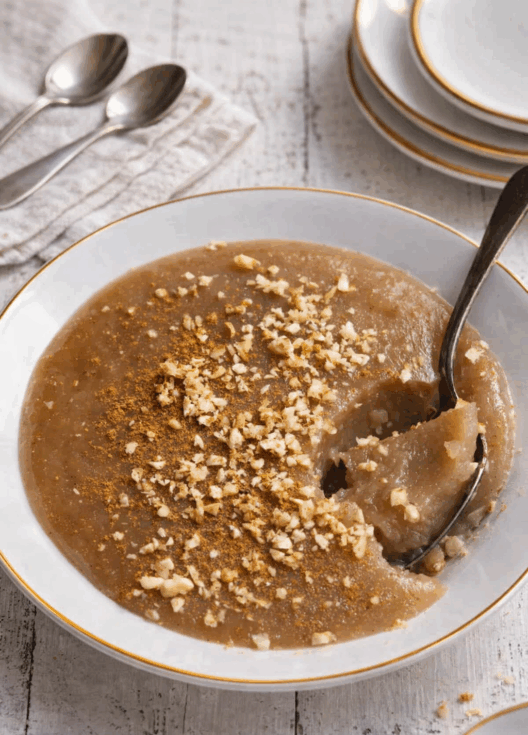
There are desserts that impress with layers and decoration, and then there are desserts like moustalevria, simple, humble, deeply rooted in tradition.
In Greece, this pudding appears when the grape harvest begins. Fresh grape must is pressed, kitchens fill with its sweet aroma, and within minutes a few spoonfuls of flour and starch turn it into something silky and comforting.
No butter, no cream, no eggs, just the pure flavor of grapes transformed into a smooth autumn dessert.
Moustalevria is naturally plant based, naturally sweet, and beautifully minimal. It sets in the refrigerator, firms up just enough, and is finished with chopped walnuts and a dusting of cinnamon. That contrast, creamy pudding, crunchy nuts, warm spice, is what makes it unforgettable.
It is the kind of dessert Yiayia would pour into small bowls and leave by the window to cool.
The kind you eat slowly, appreciating how something so simple can feel so rich.
Crockery & ingredients love using—find them all here: My Mediterranean Greek Pantry
1200 g fresh grape must
3 tablespoons all purpose flour
3 tablespoons niseste or potato starch * or organic cornstarch
For serving
Finely chopped walnuts
Ground cinnamon
Directions
In a bowl, add 200 g of the grape must along with the flour and cornstarch. Whisk well until completely smooth and no lumps remain.
Place a saucepan over medium to high heat and pour in the remaining grape must. Warm it gently, without letting it boil.
Add the flour mixture to the saucepan and stir continuously. Bring the mixture to a gentle boil and cook until it thickens into a smooth, glossy pudding.
Remove from the heat and pour into serving bowls. Allow it to cool, then refrigerate for 1 to 2 hours until fully set.
Serve chilled, topped with chopped walnuts and a generous sprinkle of cinnamon.
Ingredient Note About Starch
In Greece, this dessert is traditionally thickened with niseste, a fine starch used in many classic recipes.
Outside of Greece, niseste is not always easy to find. In most cases, it is very similar to cornstarch, although the texture can vary slightly depending on the source.
You may sometimes find it labeled as Turkish wheat starch or nisasta in international markets. It is also available online, including on Amazon,(Here), if you would like the most authentic option.
If you cannot find niseste, you can substitute with one of the following:
Option 1 – Cornstarch
Use the same amount, 3 tablespoons.
Cornstarch gives a stable, classic pudding texture.
Whisk it thoroughly into cold grape must before adding it to the saucepan.
Bring the mixture to a gentle boil and cook just until thickened. Do not overboil.
Option 2 – Potato Starch
Use 3 tablespoons for a firmer result or 2½ tablespoons for a softer, silkier texture.
Important instructions when using potato starch:
Always dissolve it completely in cold grape must.
Add it to the warm must and stir continuously.
Once it thickens and reaches a gentle boil, remove it from the heat immediately.
Do not let it simmer for long, as overcooking can make the texture slightly sticky.
For a smoother and more refined texture, I personally prefer potato starch.


Leave a Reply