


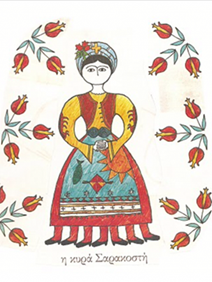
SARAKOSTI / GREEK LENTEN CALENDAR
In Greece, we call this 40-day Lenten period Sarakosti, which literally means “forty days” in Greek. However, Great Lent actually lasts 50 days! Many years ago, the Lenten fast was indeed 40 days long, and that is how the name Sarakosti came about. Although the fasting period has since been extended, the name remained the same.
Great Lent begins on Clean Monday and ends on Holy Saturday, after midnight. For Orthodox Christians, this is a time of prayer, attending church, and fasting from foods that contain blood—such as meat, poultry, and their by-products (milk, cheese, eggs, etc.), as well as fish with backbones. Shellfish, however, are permitted. On certain days, even olive oil and wine are restricted.
The purpose of fasting is not only to cleanse the body and spirit but also to cultivate discipline in preparation for the celebration of Christ’s Resurrection. Throughout Lent, there are significant religious observances:
Ψυχοσάββατα (Soul Saturdays)
Let’s go back to Apokries for a moment. The last two Saturdays of Apokries are dedicated to remembering the dead and are called Ψυχοσάββατα (Soul Saturdays). The first Saturday of Lent is the final Ψυχοσάββατο and also marks the feast day of Άγιοι Θεόδωροι (Saint Theodore and Saint Theodora).
On these days, it is customary to prepare κόλλυβα (koliva)—a dish made of wheat, nuts, and dried fruits—which is blessed in church and shared among the congregation for the forgiveness of the departed souls. Additionally, this last Ψυχοσάββατο coincides with the name day of Theodoros and Theodora.
Η Κυριακή της Ορθοδοξίας (Sunday of Orthodoxy)
The first Sunday of Lent is known as the Sunday of Orthodoxy, commemorating the triumph of the Orthodox faith over the heresies led by Arius. This day celebrates the restoration of holy icons in churches and homes, a pivotal moment in Orthodox history.
Οι Χαιρετισμοί (Salutations to the Virgin Mary)
On the first five Fridays of Lent, Orthodox Christians gather in churches for the Χαιρετισμοί (Heretismoi), or Salutations to the Virgin Mary. During these services, they chant the Ἀκάθιστος Ὕμνος (Akathistos Hymnos), a beautiful hymn dedicated to the Theotokos (Mother of God). The name Akathistos (meaning “not seated”) comes from the tradition of standing throughout the hymn as a sign of reverence.
These are the most important events of Great Lent, leading up to Holy Week. Greeks observe this period with great respect, knowing that once it concludes, they will joyfully celebrate Easter, breaking the fast with traditional feasts.
Κυρά Σαρακοστή (Lady Lent) – An Old Greek Tradition
An old Greek tradition that helped Orthodox Christians observe the strict three-day fast at the beginning of Lent involves Kyra Sarakosti (Lady Lent).
In the past, devout women, especially, would fast for the first three days of Clean Week, consuming absolutely nothing—similar to monastic practices. When the three days were over, they would resume eating but only dry foods for the remainder of the week.
To keep track of the seven weeks of Lent, people would draw Kyra Sarakosti on a piece of paper. She was depicted as a woman with no mouth (symbolizing fasting), with her hands crossed in prayer, and with seven legs, representing the seven Sundays of Lent.
Each Saturday, one leg would be cut off until Holy Saturday, when the last leg was removed. In some regions, such as Chios, the final leg was hidden inside a dried fig or walnut, and whoever found it was considered blessed.
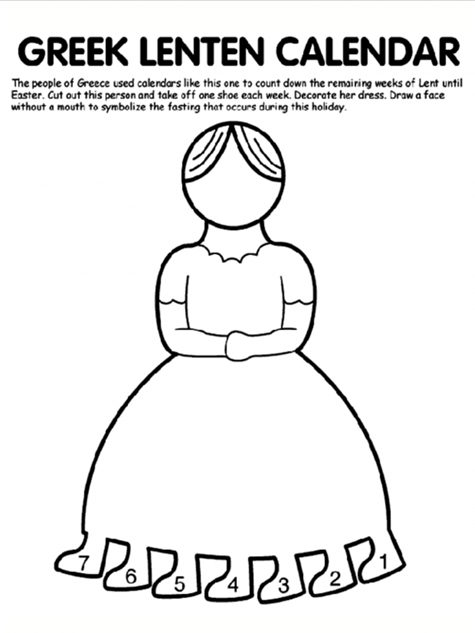
The people of Greece used calendars like this one to count down the remaining weeks of Lent until Easter.
1. Use colored pencils, or markers to decorate the girl’s dress.
2. Draw a face without a mouth to symbolize the fasting that occurs during this holiday.
3. Cut out the picture, and take off one of her shoes each week.


Leave a Reply